About this resource
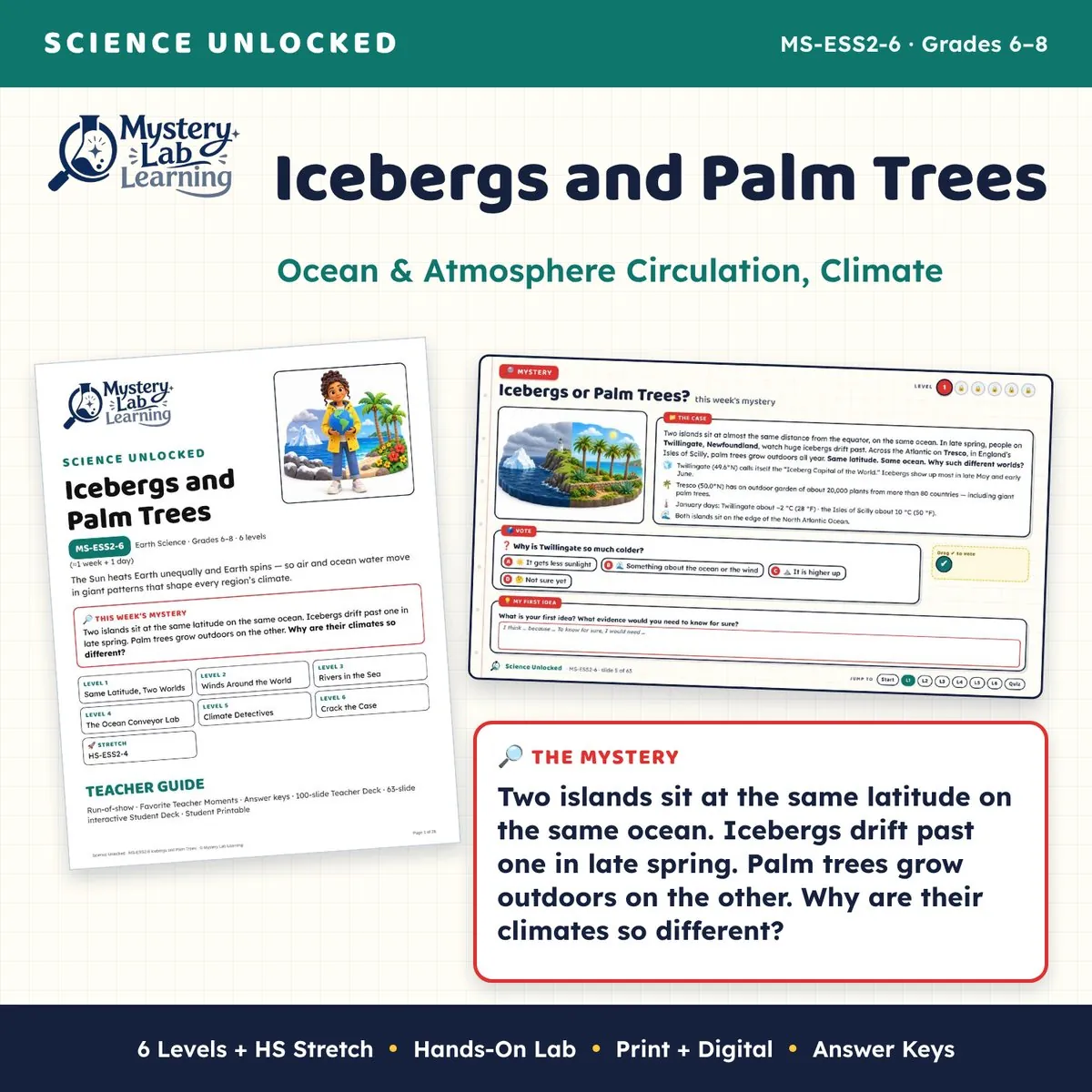
Two islands sit at the same latitude on the same ocean. Icebergs drift past one in late spring. Palm trees grow outdoors on the other. Why are their climates so different? The Sun heats Earth unequally and Earth spins — so air and ocean water move in giant patterns that shape every region’s climate. In this one-week, 6-level Ocean & Atmosphere Circulation, Climate unit for middle school science (NGSS MS-ESS2-6), students investigate a real mystery, then use their evidence to crack the case.
Icebergs and Palm Trees is part of Science Unlocked, a series of mystery-driven lesson sets. Every set opens with a real, surprising phenomenon, builds the science one level at a time, and ends with students solving the mystery in a claim-evidence-reasoning (CER) write-up.
Topics: climate, ocean currents, climate and weather, claim evidence reasoning (CER), science phenomenon, review games.
What's included
- Teacher Deck (100 slides, PowerPoint). Answers are highlighted on the slides. Speaker notes tell you what to say and do, what to watch for, and how to support students or push GT students further. Prep slides and answer keys are hidden, so they skip during a slideshow.
- Interactive Student Deck (63 slides, PowerPoint + PDF). Students type in boxes, drag cards and check marks, and rate their confidence. Assign one copy per student in Google Classroom or your LMS.
- Google Slides versions of both decks. Click a button in the Google Slides Links PDF to make your own copy in Google Drive.
- Teacher Guide (28-page PDF). The standard, a week at a glance, a materials list, misconceptions to watch for, a run-of-show for every level, answer keys and sources.
- Student Printable (22-page PDF + a low-ink greyscale copy). The same tasks on paper in 12 pt type, for students without devices, sub days, or anyone who learns better with a pencil. Slide numbers match the Student Deck.
- Self-grading digital activity. SCORM 2004 and SCORM 1.2 packages for an LMS that accepts SCORM uploads, a web package, and a single HTML file that opens in any browser. Notes, sorts, matches, tables and multiple-choice items grade themselves, and students get a copy-and-paste backup of their work. A 2-page teacher quick start is included.
- Two whole-class review games that open in any browser: a Jeopardy-style game (6 categories, 30 clues) and Trashketball, where teams answer on whiteboards and then shoot for points.
- Kahoot! and Blooket import files. 56 review questions, one file per level plus an all-levels file, with a printable answer key.
- Start Here guide, HTML & SCORM how-to guide and Terms of Use, so you know which file to open first.
The 6 levels (about one 45–50 minute class each)
- Same Latitude, Two Worlds. Weather vs. climate, latitude, unequal heating. Key activities: Iceberg-vs-palm mystery, weather/climate sort, sunlight-angle model.
- Winds Around the World. Convection cells, Coriolis effect, wind belts. Key activities: Spin Test (paper plate), label the wind-belt globe.
- Rivers in the Sea. Surface currents, gyres, continents steer currents. Key activities: Bath-toy spill, world gyre map, Gyre-in-a-Pan lab, label the North Atlantic.
- The Ocean Conveyor Lab. Density (temperature, salt), deep currents, conveyor belt. Key activities: Sink or Rise? colored-water lab, Lab Conclusion CER, label the conveyor.
- Climate Detectives. Latitude, altitude, mountains, ocean, currents, winds. Key activities: Climate Detective data table, climate-clue sort.
- Crack the Case. Stretch HS-ESS2-4: El Niño changes regional climates. Key activities: El Niño model, Stretch CER, Crack the Case CER.
Built for real classrooms
- Every level follows the same routine: "I can" targets with a confidence check, a warm-up, copy-it notes with a word bank, hands-on practice, a checkpoint students must pass to unlock the next step, and an exit ticket. A 10-item Mini Quiz wraps up the week.
- Level 1 opens with a Power-Up on the earlier-grade ideas this standard builds on (3-PS2-1, 3-ESS2-1, 3-ESS2-2, 5-ESS2-1).
- The last level includes a high school Stretch (HS-ESS2-4) that every student tries and advanced students can take further.
- Hands-on lab (Spin Test: Can a Straight Line Curve?). Student materials list: A paper plate with a dot in the center; A marker and a ruler; A turntable (lazy Susan) — or an unsharpened pencil through a hole in the plate’s center as an axle; A partner. Safety notes are on the slides and in the Teacher Guide.
- Support is built in: word banks, sentence starters and support notes on the slides, plus GT extensions.
Standards
- NGSS MS-ESS2-6: Develop and use a model to describe how unequal heating and rotation of the Earth cause patterns of atmospheric and oceanic circulation that determine regional climates.
- SEP: Developing and Using Models · DCI: ESS2.C, ESS2.D · CCC: Systems and System Models
- Stretch: HS-ESS2-4
- CCSS connections: RST.6-8.7, SL.8.5, WHST.6-8.9
Try the digital activity first
- Not sure the self-grading activity will work in your LMS? Download the FREE HTML & SCORM Sample and test it with your students before you buy.
Save with a bundle
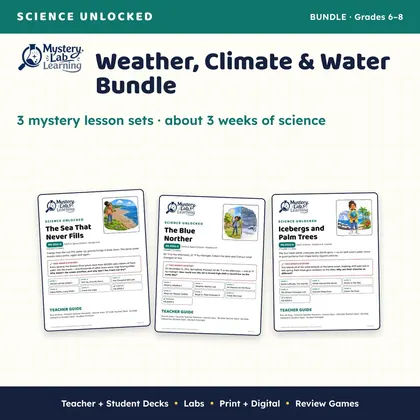
- Weather, Climate & Water (3 sets)
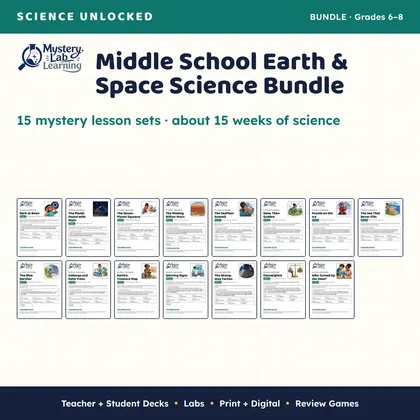
- Middle School Earth & Space Science (15 sets)
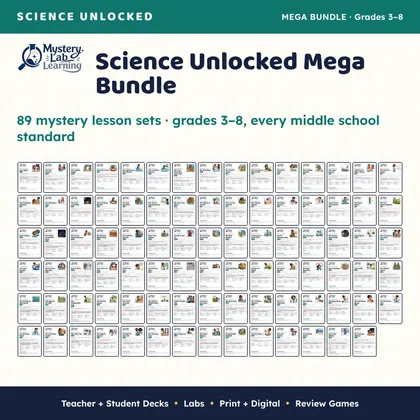
- Science Unlocked Mega Bundle (all 89 sets)
Teach next
- The Sea That Never Fills (MS-ESS2-4)
- The Blue Norther (MS-ESS2-5)
More from Mystery Lab Learning
- See every Science Unlocked set, and follow to hear when new ones are added, at Mystery Lab Learning.
Good to know
- The illustrations in this resource were created with AI image tools, and AI tools helped draft the lesson text. Every slide, answer key and lab step was then fact-checked against the sources listed in the Teacher Guide and proofread.
- Kahoot!, Blooket, Jeopardy!, Google Slides and PowerPoint are trademarks of their owners. This resource is not affiliated with or endorsed by them.
- License: one teacher, for use with their own students. Please buy an additional license for each colleague who uses it.